What is VWAP? A Plain English Guide for New Investors
Learn what VWAP means in stock trading. Simple explanation of Volume Weighted Average Price, how it's calculated, and practical strategies for beginners. No jargon.
StockGenie Team
December 2, 2025
If you've ever bought a stock and immediately wondered "Did I pay too much?"—you're not alone. Every trader faces this question. The good news? There's a simple indicator that can answer it: VWAP.
VWAP (Volume Weighted Average Price) tells you the average price a stock has traded at throughout the day, weighted by volume. Think of it as the "fair price" baseline for the day. If you bought Apple stock at $290 and VWAP is $285, you paid above average. If you bought at $282, you got a deal.
But VWAP is more than just a reference point. Professional traders use it to time entries, spot reversals, and identify institutional buying pressure. And the best part? You don't need a finance degree to use it effectively.
VWAP in One Sentence
VWAP is the average price a stock has traded at during the day, giving more weight to prices where more shares changed hands.
That's it. If a stock traded 1 million shares at $100 and 100 shares at $110, VWAP weighs the $100 price much more heavily. It reflects where most of the trading actually happened.
How VWAP is Calculated (Don't Worry, It's Simple)
You'll never have to calculate VWAP yourself—every trading platform shows it automatically. But understanding the math helps you use it better.
The Simple Version: VWAP = (Total dollars traded) ÷ (Total shares traded)
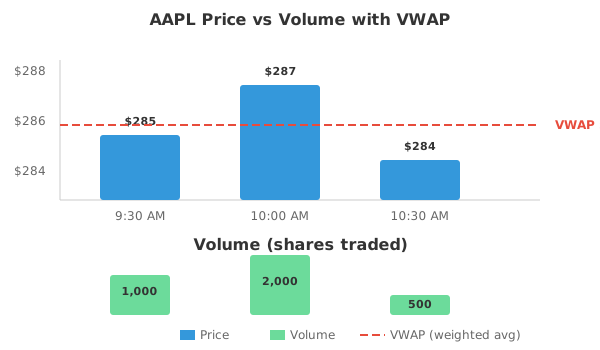
Example with Real Numbers: Let's say Apple (AAPL) trades for one hour:
- 9:30 AM: $285 per share, 1,000 shares traded = $285,000
- 10:00 AM: $287 per share, 2,000 shares traded = $574,000
- 10:30 AM: $284 per share, 500 shares traded = $142,000
Total dollars traded: $285,000 + $574,000 + $142,000 = $1,001,000 Total shares traded: 1,000 + 2,000 + 500 = 3,500 shares
VWAP = $1,001,000 ÷ 3,500 = $286.00
Notice how the 10:00 AM price ($287) had the most influence because that's when the most volume traded. That's the "weighted" part of Volume Weighted Average Price.
Why Traders Use VWAP (3 Practical Reasons)
1. Fair Price Reference
VWAP answers the question: "Am I buying at a good price right now?"
- Above VWAP = You're paying more than most people paid today
- Below VWAP = You're getting a better-than-average price
Real-world analogy: Imagine you're buying concert tickets. VWAP is like the average price people paid. If most people paid $50 and you're paying $80, you know you're buying late/high. If you're paying $40, you're getting a deal.
2. Entry and Exit Timing
Many traders use VWAP as a support/resistance level:
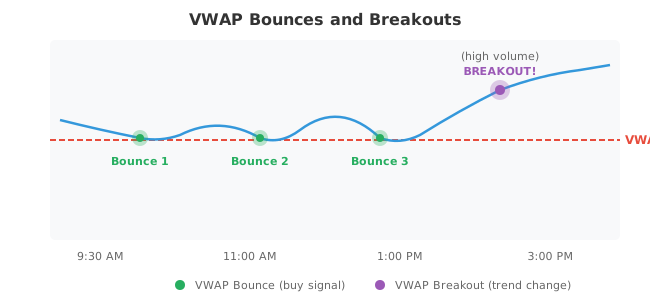
- When price drops to VWAP and bounces up = potential buy signal
- When price breaks through VWAP with volume = potential trend change
Example: Tesla (TSLA) is trading at $435 at 2:00 PM. VWAP is $428. If the stock drops to $428 and immediately bounces back up, traders see this as VWAP "supporting" the price.
3. Institutional Benchmark
Big institutions (mutual funds, hedge funds) often try to execute orders near VWAP. Why? Because it's considered a "fair" price—neither buyers nor sellers can claim they got ripped off.
When you see large volume trades happening right at VWAP, it's often institutions executing big orders.
VWAP Trading Strategies for Beginners
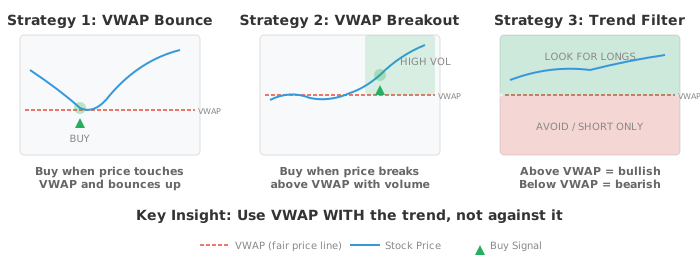
Strategy 1: The VWAP Bounce
Setup: Stock is in an uptrend, price pulls back to VWAP Signal: Price touches VWAP and reverses upward Action: Buy when price confirms the bounce (moves 0.5-1% above VWAP)
Example:
- AAPL opens at $284, rallies to $290 by 11 AM (VWAP: $286)
- At 1 PM, AAPL drops to $286 (touching VWAP)
- Price bounces back to $287.50 within 15 minutes
- Buy around $287.50, targeting the day's high near $290
Why it works: In uptrends, VWAP often acts as support. Buyers see it as a "discount" and step in.
Strategy 2: The VWAP Breakout
Setup: Stock consolidates near VWAP for 30+ minutes Signal: Strong volume breakout above VWAP Action: Buy the breakout, especially if volume is 2x average
Example:
- TSLA trades between $425-$432 all morning (VWAP: $428)
- At 2 PM, TSLA breaks through $432 on heavy volume
- Buy at $432-434, targeting $445+
Why it works: When price breaks VWAP with volume, it signals a shift in buying pressure.
Strategy 3: Above vs Below VWAP (Trend Filter)
Simple rule:
- Price above VWAP = Look for long trades only
- Price below VWAP = Look for short trades or stay out
Why it works: VWAP acts as a trend filter. Focus your trades in the direction of the dominant trend.
Common VWAP Mistakes (And How to Avoid Them)
These are the mistakes that cost beginners the most money. Read carefully!
Mistake 1: Using VWAP for Swing Trading
Problem: VWAP resets every day at market open. It's a DAY TRADING indicator, not for multi-day holds.
Fix: For swing trades (holding 2+ days), use moving averages (20-day MA, 50-day MA) instead.
Mistake 2: Ignoring Volume Context
Problem: VWAP touch on low volume means nothing. You need confirmation.
Fix: Only trade VWAP signals when volume is at least 50% above average.
Mistake 3: Fighting the Overall Trend
Problem: Buying VWAP bounces in a downtrend, or shorting VWAP rejections in an uptrend.
Fix: Use VWAP WITH the trend, not against it.
Mistake 4: Trading VWAP Alone
Problem: No indicator works in isolation.
Fix: Combine VWAP with RSI (overbought/oversold), moving averages (trend), and support/resistance levels.
How to Use VWAP in StockGenie
Here's where StockGenie makes VWAP trading dramatically easier.
Instead of staring at charts all day waiting for VWAP touches, you can set up natural language alerts:
Example 1: "Alert me when AAPL touches VWAP"
- StockGenie creates a VWAP touch alert
- You get notified the moment it happens
- No chart watching required
Example 2: "Watch TSLA for VWAP breakouts above $250"
- Genie creates a combo rule: VWAP crossover + price threshold
- Filters out low-volume false signals automatically
Example 3: "Tell me when MSFT closes above VWAP for 30 minutes"
- Confirms sustained buying pressure
- Reduces false signals from momentary price pops
The key difference: Traditional platforms make you manually draw VWAP lines and set complex alerts. Genie understands what you want in plain English and configures everything automatically.
Plus, StockGenie's 24/7 monitoring means your alerts run even when you're not logged in.
Key Takeaways
-
VWAP = Average price weighted by volume — the "fair price" benchmark for the day
-
Three main uses:
- Reference point (am I buying high or low?)
- Support/resistance level (bounces and breakouts)
- Institutional benchmark (where smart money trades)
-
Simple strategies:
- VWAP bounce: Buy when price touches VWAP and reverses
- VWAP breakout: Buy when price breaks through VWAP with volume
- Trend filter: Only trade in the direction of VWAP position
-
Avoid common mistakes:
- Don't use VWAP for multi-day trades (day trading only)
- Don't trade low-volume VWAP signals
- Don't fight the overall trend
- Don't rely on VWAP alone
-
Make it easy with automation:
- Let StockGenie watch VWAP for you
- Natural language alerts (no charting expertise needed)
- 24/7 monitoring so you never miss a signal
Try VWAP Alerts Free
Ready to start using VWAP without staring at charts all day?
StockGenie's Explorer tier is 100% free and includes:
- 12 full AI stock analyses per month
- Unlimited basic VWAP monitoring
- Natural language alert creation ("Watch AAPL for VWAP bounces")
- Real-time notifications
No credit card required. Set up your first VWAP alert in under 60 seconds.
Disclaimer: This article is for educational purposes only and is not investment advice. VWAP is one of many tools traders use. Always do your own research and consider your risk tolerance before trading.