Markets at All-Time Highs: Is This an AI Bubble?
Markets are at all-time highs and everyone's asking about an AI bubble. Here's what the data shows, what history tells us, and how to think about it without panicking.
StockGenie Team
December 8, 2025
Open any financial news site right now and you'll see some version of this headline:
"Is AI the Next Dot-Com Bubble?" "Markets Hit Record Highs - Time to Sell?" "NVIDIA Up 800% - How Long Can This Last?"
If you're a newer investor, this is probably making you anxious. You might be sitting on gains and wondering: Should I take profits? Is this thing about to crash?
Let's look at what the data actually shows—not to tell you what to do (that's not our job), but to help you think clearly about it.
First: Yes, Markets Are at All-Time Highs. That's Not Automatically Bad.
Here's something that surprises most people: markets are at all-time highs about 7% of all trading days.
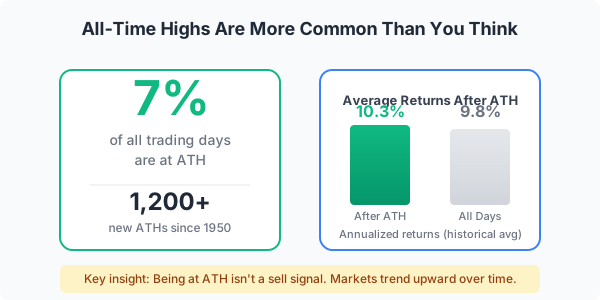
That sounds rare until you realize markets trend upward over time. Being at ATH is literally what healthy markets do.
Historical context:
- If you only invested when markets were NOT at all-time highs, you'd miss most of the best returns
- The S&P 500 has hit new ATHs over 1,200 times since 1950
- Returns after ATHs are actually better than average (roughly 10.3% vs 9.8% annualized)
The point: "Markets are high" alone isn't a reason to sell. It's not a reason to buy either. It's just... where we are.
So What IS Different About 2025?
Here's where it gets more nuanced. A few things stand out:
1. Concentration in a Few Stocks
The "Magnificent 7" (Apple, Microsoft, Google, Amazon, Meta, NVIDIA, Tesla) now represent roughly 30% of the entire S&P 500's market cap.
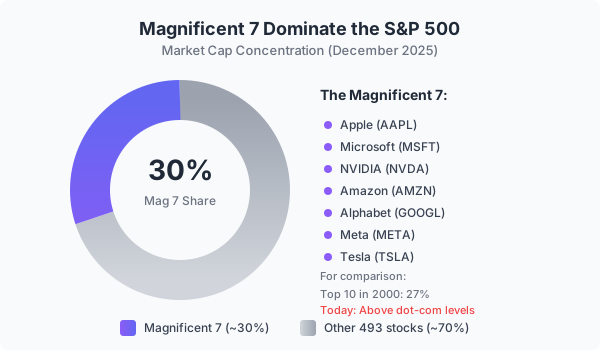
What this means: When people say "the market is up 25%," they often mean "7 stocks are up 40% and everything else is up 10%." The average stock hasn't had the same run.
Historical parallel: In 2000, the top 10 stocks were 27% of the S&P 500. We're now above that level.
2. Valuations Are Stretched (But Not Insane)
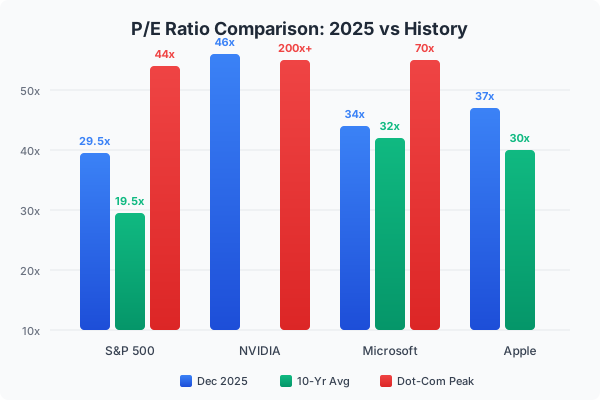
| Metric | Current (Dec 8, 2025) | 10-Year Avg | Dot-Com Peak (2000) |
|---|---|---|---|
| S&P 500 P/E | 29.5x | 19.5x | ~44x |
| NVIDIA P/E | 46x | N/A | Cisco was 200x |
| MSFT P/E | 34x | 32x | ~70x |
| AAPL P/E | 37x | 30x | N/A |
Translation: Yes, things are expensive—the S&P 500 is trading 50% above its 10-year average P/E. But we're not at dot-com extremes. The key difference? These companies actually have earnings. Cisco in 2000 traded at 200x earnings. NVIDIA at 46x is rich, but it's generating $60B+ in annual profit.
3. The "AI Will Change Everything" Narrative
Every bubble has a story. Dot-com was "the internet changes everything." Housing was "real estate never goes down."
The AI story is: "AI will transform every industry and these companies will capture all the value."
The honest truth: AI probably will be transformative. The question is whether current prices already reflect that transformation—or whether there's still upside.
Nobody knows the answer. Anyone who claims certainty is selling something.
Signs of Bubble vs. Signs of Healthy Growth
Let's be specific about what to watch:
Signs That Worry Analysts
- Retail speculation in meme-like behavior: Options volume on AI stocks, social media-driven pumps
- Companies adding "AI" to names for stock pops: (Remember when companies added ".com" to their names in 1999?)
- Unprofitable AI companies at massive valuations: Some smaller AI plays trading at 50x revenue with no earnings
- "This time is different" mentality: Dismissing all valuation concerns
Signs This Isn't 2000
- Actual earnings: NVIDIA made $60B last year. Amazon Web Services is profitable. These aren't eyeball-counting startups.
- Cash flows: Big tech generates massive free cash flow and buys back stock
- Business model clarity: We know how these companies make money (ads, cloud, chips, subscriptions)
- Interest rates: Higher rates have actually made investors more discerning, not less
What Smart Investors Do in This Environment
Notice I said "smart investors," not "what you should do." We're not financial advisors. But here's what experienced investors tend to do when markets feel uncertain:
1. They Don't Try to Time the Top
The graveyard of investing is full of people who sold in 2017, 2019, 2021, and 2023 because "this feels like a top."
The market has a saying: "Markets can stay irrational longer than you can stay solvent."
Translation: Even if you're right that a correction is coming, you might be wrong about when by months or years.
2. They Check Their Risk Tolerance
Instead of asking "is this a bubble?", better questions:
- If my portfolio dropped 30% tomorrow, would I panic-sell?
- Am I investing money I'll need in the next 2-3 years?
- Is my portfolio concentrated in a few hot stocks?
If you'd panic at a 30% drop, you might have too much risk—regardless of whether a bubble exists.
3. They Rebalance, Not Sell Everything
Some investors take a middle path:
- Trim positions that have grown too large (e.g., if NVDA is now 20% of your portfolio)
- Move some gains into less volatile assets
- Set trailing stop-losses to protect profits while staying in the game
This isn't "calling the top"—it's risk management.
4. They Keep Watching, Not Guessing
Markets give signals before major turns. The investors who navigate corrections best are the ones paying attention to:
- Earnings reports (are AI companies hitting revenue targets?)
- Guidance (what are CEOs saying about future demand?)
- Technical levels (where are the support/resistance zones?)
- Breadth (are gains broadening or narrowing?)
How StockGenie Helps in Uncertain Markets
This is where we'll be transparent about our product—not because we're pushing it, but because this is exactly what we built it for.
Scenario: You're nervous about a potential pullback but don't want to sell everything and miss further upside.
What StockGenie lets you do:
1. Set Pullback Alerts
"Alert me if NVDA drops 10% from current price"
You don't have to watch charts all day. Genie monitors and notifies you if your trigger hits.
2. Ask Genie for Analysis
"Is NVDA overvalued right now?"
StockGenie pulls fundamental + technical data and gives you a balanced view:
- Current P/E vs historical
- RSI (overbought/oversold)
- Distance from moving averages
- Bull case vs bear case
3. Monitor Key Levels
"Watch SPY and alert me if it breaks below the 50-day moving average"
Major indices breaking key technical levels often signal broader corrections. You can monitor without obsessing.
4. Track Your Positions 24/7
Even when you're sleeping or in meetings, StockGenie monitors your watchlist. If something moves significantly, you'll know.
The honest pitch: We can't tell you whether to sell. But we can make sure you're not blindsided—and that you have data, not just feelings, when making decisions.
The Bottom Line
Is this an AI bubble? Maybe. Maybe not. Anyone who claims certainty is guessing.
What we do know:
- Markets at ATH isn't inherently bearish
- Valuations are stretched but not at dot-com extremes
- The Magnificent 7 concentration is historically high
- These companies have real earnings (unlike 2000)
- Nobody can consistently time tops
What you can control:
- Your risk exposure
- Your monitoring and alerting
- Your emotional reactions
- Whether you make decisions based on data or fear
Markets will correct eventually—they always do. The question isn't "if" but "when" and "how much." The investors who do best aren't the ones who predict perfectly; they're the ones who stay informed, manage risk, and don't panic.
What We're Watching
At StockGenie, we're watching several key indicators. Here's what matters:
-
NVDA earnings reactions: The AI bellwether. How the market reacts to their reports tells us about sentiment.
-
Breadth indicators: Are more stocks participating in the rally, or is it narrowing?
-
Bond yields: Rising yields can pressure growth stocks. The 10-year Treasury matters.
-
Volatility (VIX): Complacency (very low VIX) often precedes corrections.
-
Earnings revisions: Are analysts raising or lowering estimates for AI companies?
We'll keep you updated as things develop.
Try It Yourself
Not sure how to think about your own portfolio in this environment?
Ask StockGenie: "Is [your stock] overvalued right now?" or "Set an alert if [your stock] drops 15%."
Start free: stocks.goaigenie.com - 12 free analyses, no credit card required.
Disclaimer
This is not financial advice. This article is for educational and informational purposes only. We are not licensed financial advisors, and nothing in this article constitutes a recommendation to buy, sell, or hold any security.
Markets are unpredictable. Past performance does not guarantee future results. Always do your own research and consider consulting a qualified financial advisor before making investment decisions.
The views expressed represent our analysis of publicly available data as of December 8, 2025. Market conditions change rapidly.
Data sources: MacroTrends, GuruFocus, FactSet, Multpl